

TL;DR: Snapchat still matters at scale, and that makes better measurement hard to ignore. Snap reported 469 million daily active users in Q2 2025, while Spotlight reached more than 550 million monthly active users. Snap also says Snapchat reaches more than 75 % of 13 to 34 year olds in over 25 countries. That is the context behind this update: Stellar now lets teams track and report Snapchat Stories and Spotlights, making cross platform campaign reporting more complete, more efficient, and more reliable.
Snapchat Still Matters
Influencer campaigns rarely live on one platform anymore, but reporting still often does. That gap becomes a real problem when creator activity on Snapchat remains outside the measurement workflow. For brands and agencies, this is no longer a marginal issue.
Snapchat reported 469 million daily active users in Q2 2025, up 9 % year over year, and said Spotlight reached more than 550 million monthly active users on average during the quarter, with time spent up 23 % year over year. In parallel, Snapchat says it reaches more than 75 % of 13 to 34 year olds in over 25 countries, which helps explain why the platform still plays an important role in attention, discovery, and creator led visibility.
In France, local audience signals remain meaningful too: DataReportal says Snapchat’s ad reach was equivalent to 46.3 % of French adults aged 18+ at the beginning of 2025, while BDM reports that Snapchat counts 26 million monthly active users in France, including 19.7 million daily active users, and covers 91 % of 15 to 24 year olds and 64 % of 25 to 40 year olds. This is why we launched Snapchat content tracking in Stellar. By adding support for Snapchat Stories and Spotlights, we are helping influencer marketing managers and agency project managers build more complete reporting, with less manual work and fewer blind spots across platforms.

Why Snapchat deserves renewed attention
The case for Snapchat does not rest on novelty. It rests on relevance. The platform continues to matter in campaign execution, not just in audience reach. Snap’s recent investor communications point to improved advertising demand, continued investment in advertiser performance, and growing use of formats such as Sponsored Snaps, which the company says can lift conversions and lower cost per action when included in campaigns. In other words, Snapchat is not simply a channel with scale. It is a platform that brands are actively using to deliver campaign outcomes.
For teams working across multiple social platforms, Snapchat has often remained visible in campaign planning but less visible in campaign evaluation. That creates a disconnect. A platform can be strategically important long before it is operationally well measured. In Snapchat’s case, that gap has become harder to defend. Snap’s continued commercial investment in France, including the opening of a new Paris office in 2025, underlines that the market matters strategically. At the same time, recent France based examples from Snapchat for Business, including campaigns with McDonald’s France, show that the platform continues to play a real role in brand visibility and campaign activation. When a platform is present in live campaign execution, it cannot be treated as peripheral in campaign evaluation.
This is particularly important for agencies and brands that work with younger audiences or with creators whose communities are spread across several channels. In those cases, Snapchat is not always the primary reporting platform, but it is often part of the performance reality. If a channel contributes to campaign delivery, it should also contribute to campaign understanding. That is the shift behind this update.
The reporting gap in multi platform campaigns
The challenge is not that teams ignore Snapchat. The challenge is that multi platform campaigns often produce multi speed reporting. Some channels are easy to capture, compare, and present. Others stay fragmented, manual, or partially invisible. When that happens, reporting becomes less complete than the campaign itself.
For influencer marketing managers and agency project managers, this creates practical problems at every stage. It makes it harder to consolidate creator outputs in one place. It complicates post campaign reviews. It weakens cross platform comparisons. And it increases the amount of manual checking needed to build a report that feels robust enough to share internally or with clients. The more fragmented the measurement, the less reliable the analysis.
This also affects decision making beyond a single campaign. When one platform sits outside the reporting workflow, teams risk undervaluing certain creators, misreading channel contribution, or over relying on the platforms that are easiest to measure. That is not just a reporting issue. It is a planning and performance issue.
In other words, the real problem is not missing data for its own sake. The real problem is that incomplete measurement leads to incomplete judgment. As influencer marketing becomes more structured and more accountable, that becomes a bigger operational weakness. Reporting needs to follow the full campaign, not just the easiest parts of it.
Track Snapchat Stories and Spotlights in Stellar
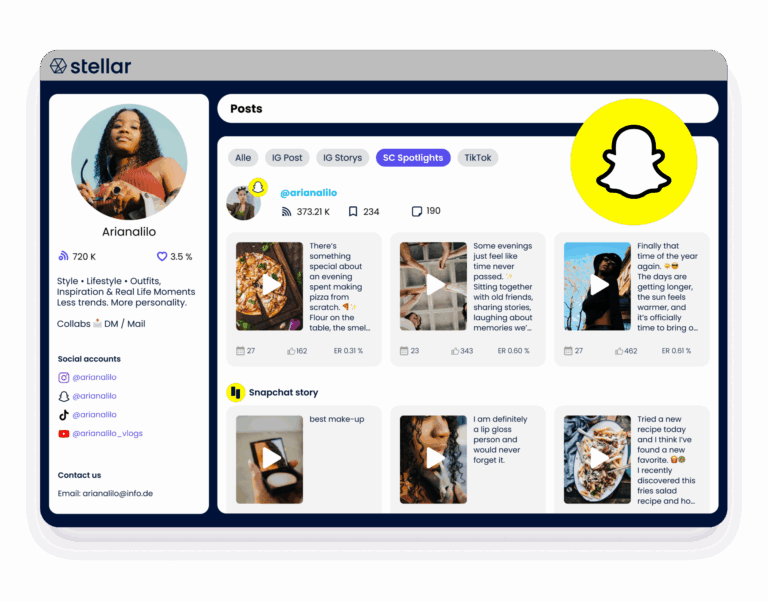
This update tackles a key pain point head-on: Snapchat content no longer has to sit outside your campaign reporting. With Stellar, teams can now seamlessly add Snapchat accounts to their influencer portfolios and automatically track and report Stories and Spotlights directly in the platform. This makes it far easier to integrate Snapchat activity into the same comprehensive measurement workflow as the rest of your campaigns, delivering more complete, efficient, and reliable cross-platform reporting.
That changes the day to day reality of reporting in a few important ways. First, it gives teams a more complete view of creator output across platforms. Second, it reduces the need to patch campaign reporting together manually. Third, it makes performance review more consistent by giving Snapchat content a clearer place in post campaign analysis. This is not just about adding another platform. It is about making cross platform reporting more operationally sound.
In practice, that means influencer marketing managers and agency project managers can work with a reporting setup that is closer to the way campaigns actually run. Instead of treating Snapchat as an exception, they can integrate it into a more unified process. The value of the update is not only visibility. It is consistency, efficiency, and stronger analysis.
A Clearer View of Campaign Performance
As influencer marketing matures, the standard for measurement is changing. Teams are no longer judged only on campaign execution. They are also judged on how clearly they can evaluate results, compare performance, and explain what worked across channels. That makes complete reporting more important than ever.
Snapchat’s continued relevance means it deserves a proper place in that picture. When creators are active on the platform and audiences are engaging there, leaving Snapchat outside the reporting workflow creates a blind spot that becomes harder to justify. What cannot be measured properly is harder to analyse, harder to compare, and harder to act on.
That is why this update matters. By bringing Snapchat Stories and Spotlights into Stellar, we are helping brands and agencies move toward reporting that is more complete, more efficient, and more aligned with the real shape of creator campaigns today. As influencer marketing becomes more measurable, the expectation is no longer partial visibility. It is a reporting workflow that captures the full campaign reality.
Ready to track Snapchat campaigns with ease?
See how Stellar helps brands and agencies track Snapchat Stories and Spotlights alongside their other social channels, so campaign reporting becomes more complete, more efficient, and easier to compare across platforms.