
TL;DR:The Fanblast controversy involving a well-known German influencer did not emerge from a brand campaign, but from internal creator-business dynamics. For European marketers, the case illustrates why brand safety must be understood as continuous ecosystem monitoring rather than a campaign checklist. Stellar helps brands make early signals, contextual risks and creator dynamics visible over time, enabling informed brand safety decisions before issues escalate publicly.
When Influencer Scandals Become Brand Safety Signals
The Fanblast controversy did not begin with a viral tweet or a brand backlash.
It began with allegations raised by former collaborators inside a creator-led business.
Fanblast, a German event and creator venture co-founded by Knossi, one of the most prominent entertainers in the German-speaking market,came under public scrutiny after former creators and partners publicly accused the company of broken promises, lack of transparency and problematic internal structures. According to reporting by ComicSchau, the allegations also included concerns around how creator relationships and personal contact data were handled within the Fanblast ecosystem, raising questions about trust, governance and responsibility in creator-led businesses.
As the accusations gained attention, Fanblast responded with a public video statement addressing the claims and later attempted to reframe the narrative under a “fan-first” positioning, which continued to divide public opinion rather than resolve the core concerns.
Knossi himself also issued a public response, commenting on his role and responsibility within the project.
What followed was not merely a local influencer controversy. It became a revealing case study in how brand safety risks emerge within modern creator ecosystem,long before any brand campaign is involved.
What is unfolding now, however, goes far beyond a typical influencer success narrative.
In recent months, multiple international outlets have reported that Khaby Lame has sold stakes in his business at a valuation close to $900 million, while simultaneously expanding a strategy that includes AI-generated versions of his own persona. Publications such as eMarketer describe how creators like Lame are converting viral fame into structured, scalable businesses that operate independently of constant physical presence.
This is not a publicity stunt. It is a signal.
Why This Story Broke on YouTube


Crucially, the Fanblast case did not enter public discourse through traditional media channels.
It surfaced first within the creator ecosystem itself.
Independent German YouTubers Klengan and RobBubble published long-form video analyses that examined the allegations in detail, contextualised public statements and connected scattered community feedback into a coherent narrative. Their videos functioned less as commentary and more as investigative aggregation, a format increasingly common in creator-driven media environments.
Only after these analyses reached significant traction did established online media outlets begin covering the story, referencing both the original allegations and the subsequent responses from Fanblast and Knossi.
For an international audience, the specific platforms or publications are less important than the pattern this case reveals: Brand-relevant risks are often identified, debated and validated inside creator communities long before they reach mainstream media or formal press coverage.
Why This Is Not a Typical Influencer Crisis
The Fanblast controversy differs fundamentally from classic influencer crises and this distinction is critical for understanding modern brand safety.
There was no single problematic sponsored post, no failed brand integration and no campaign that triggered immediate backlash. From a traditional brand safety perspective, there was nothing to flag at the content level.
Instead, the risk emerged elsewhere: inside a creator-led business. Over time, internal relationships, unmet expectations, questions around data handling and power dynamics accumulated quietly. These signals were visible within communities and commentary spaces, but remained outside the scope of campaign-based monitoring.
This is precisely where many brand safety approaches fall short.
They are designed to evaluate what is published, not what is developing.
The Fanblast case shows that reputational risk can build long before any “problematic content” appears and that by the time it surfaces publicly, the underlying dynamics have often been in motion for months.
Modern brand safety therefore cannot be limited to detecting problematic posts. It must extend to observing creator ecosystems as they evolve.
This represents a structural shift in influencer marketing. AI is no longer merely a tool that supports content production. It becomes part of the creator’s commercial infrastructure, a way to extend presence, output and consistency across markets.
For brands, this fundamentally changes how creator partnerships must be understood. When AI-generated versions of a creator are used, authorship and control become less clear-cut. Questions of tone, messaging and boundaries can no longer be resolved solely at the start of a campaign, because output can scale faster than personal oversight. At the same time, transparency becomes a critical trust factor. Audiences increasingly expect clarity around whether content is human-created, AI-assisted or fully generated and ambiguity can undermine credibility even when the creator’s image remains consistent.
Most importantly, brand alignment is no longer static. AI-driven creator output evolves continuously, which means that narratives, themes and public perception require ongoing observation rather than one-time approval. The Khaby Lame case illustrates how creator partnerships are turning into long-term, technology-enabled relationships that demand governance models capable of keeping pace with scale.
For brands, this means operating within an environment where content removal may occur more swiftly, where reach can decline without warning, and where posts once considered harmless may be downgraded by automated systems. Creator accounts have already reported that minor issues such as incomplete ad disclosure can limit visibility. The platform appears to be tightening compliance proactively in anticipation of further regulation.
In this environment, brands must resist the temptation to rely solely on TikTok. Campaign setups need the flexibility to shift creators and content quickly toward Instagram Reels or YouTube Shorts if needed. Platforms such as Stellar Tech empower that adaptability by enabling teams to identify creators with stable performance histories, monitor potential policy risks and maintain alternative options for campaign continuity.
Brand Safety Lives in the Creator Ecosystem
Modern influencers are no longer just media channels. They are founders, employers, investors and brand operators. Their side projects, startups and communities form complex ecosystems that brands inevitably become associated with, whether a campaign is live or not.
Risks in these ecosystems rarely emerge suddenly. They build gradually, through shifts in community sentiment, recurring critical narratives and evolving public perception across platforms. For brands, the challenge is not preventing every crisis, but recognising early signals before escalation.
Brand Safety in Stellar: From Early Signals to Informed Decisions
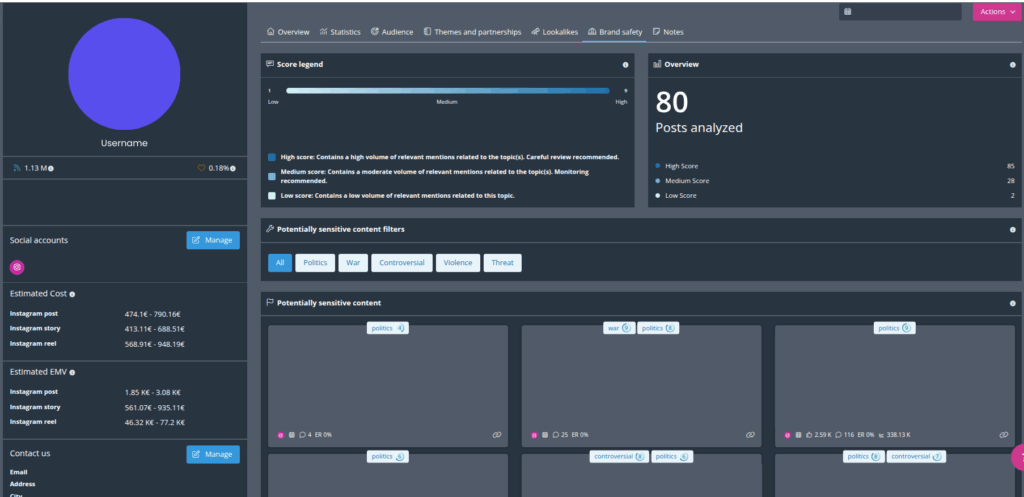
In practical terms, Stellar’s Brand Safety feature adds an additional layer of early risk detection by systematically analysing an influencer’s public textual content across platforms. Captions, post texts and story text are reviewed in multiple languages and classified into defined sensitivity categories such as politics, violence, controversial topics or alcohol.
Every signal detected is placed in context rather than being automatically excluded. This allows brands to understand what has been said, how often similar topics arise, and how topical they are. Since the analysis covers several months and is updated daily, Stellar helps teams identify emerging patterns and narrative shifts early on, long before issues escalate into public controversy.
Brand Safety in Stellar is not a blocking mechanism, but a decision-support framework that makes reputational risks visible, comparable and defensible within the broader creator ecosystem.
How Stellar Helps Brands Detect Risk Earlier
This is where Stellar becomes operationally relevant, not as a “scandal prevention tool”, but as infrastructure for continuous context and signal detection.
Within Stellar, brands and agencies can:
- Track creator activity beyond campaigns:
Creators are not only evaluated during activations. Stellar allows teams to monitor creator content, engagement patterns and platform presence over time, including phases where no brand collaboration is active. - Identify narrative and sentiment shifts:
By analysing historical performance data, content themes and engagement development, teams can detect when a creator’s public perception starts to change, long before it turns into mainstream controversy. - Document creator histories and relationships:
Stellar centralises information about past collaborations, ongoing relationships and creator trajectories. This historical context is critical when assessing whether a creator’s ecosystem aligns with long-term brand values. - Compare ecosystem stability across creators:
Instead of looking at isolated KPIs, marketers can benchmark creators by consistency, volatility and audience dynamics, helping distinguish between sustainable partnerships and structurally risky ones.
This kind of monitoring does not replace judgment. It supports better judgment, grounded in data and context rather than last-minute reactions.
A European Wake-Up Call for Marketers
While Fanblast and Knossi are primarily known in Germany, the implications extend far beyond one market. Creator-led businesses and hybrid influencer-entrepreneur models are increasingly operating across borders, making reputational dynamics inherently international.
What happens within a creator ecosystem in one country can directly shape perception, partnerships and risk assessment in others. In a connected European market, trust issues, governance questions or credibility gaps do not remain local, they travel with the creator, the company and the narrative.
The case illustrates a broader reality: Brand safety in influencer marketing is no longer about controlling messages. It is about understanding systems.
Trust is not built in campaigns.
It is built over time, across relationships, projects and public perception.
Conclusion: What the Fanblast Case Really Changes for Marketers
The Fanblast case is not just another influencer controversy. It exposes a structural blind spot in how many brands still approach influencer marketing today.
The most relevant risks did not appear in sponsored content, campaign messaging or public brand collaborations. They developed inside a creator-led business, through internal dynamics, governance gaps and unresolved expectations , long before any brand had a reason to intervene. By the time the situation became visible at scale, the underlying issues had already shaped public perception.
For European marketers, this is the real takeaway:
Brand safety can no longer be treated as a campaign checkpoint or a reactive safeguard. It requires continuous visibility into how creator ecosystems evolve , across side projects, business ventures, narratives and community sentiment , even when no campaign is live.
This is exactly where influencer marketing is maturing. Not toward more control, but toward better understanding. Not toward more rules, but toward better context.
Teams that invest in long-term creator intelligence gain something critical: the ability to recognise when a partnership is strengthening, drifting or quietly accumulating ris, early enough to make informed decisions.
The question for brands is no longer whether creator ecosystems matter.
It is whether they are equipped to see what is happening inside the, before those dynamics define the story publicly.
Ready to work with certified creators?
Book your demo and discover how Stellar helps you combine compliance and performance.
This article is brought to you by Stellar
Stellar is a SaaS platform for influencer marketing, developed by the French-Belgian company Stellar Tech and used in more than 35 countries. By using artificial intelligence, including social listening and sentiment analysis, Stellar enables companies to carry out influencer marketing campaigns in a simple and informed manner. The platform helps identify relevant ambassadors, analyse their profiles and target audiences, manage campaigns, and predict and measure the performance and ROI of these campaigns on social networks.
They trust us: La Redoute, Disney, Heineken, Air France, revolvR agency, Garmin France, Wurth France, Sonos Europe…