Blog
EU Digital Fairness Act: Brands Now Own Influencer Disclosure
Brussels wants every sponsored post labelled, and it wants brands and agencies to make sure it happens. Here is what the Digital Fairness Act changes for influencer marketing, and how to get ready before it becomes law.

TL;DR: On 11 November 2026, the European Commission proposed the Digital Fairness Act, the biggest update to EU consumer law in a generation. For influencer marketing, one sentence matters more than any other: brands and agencies will have to ensure that influencers comply with their obligations. Disclosure stops being the creator’s problem and becomes the advertiser’s. The proposal still has to pass the European Parliament and the Council, but the direction is set, and the fines it pairs with are serious. The brands that start vetting how creators label their content today will not be scrambling tomorrow.
Only One Influencer in Five Labels Every Ad
The announcement came on a Wednesday in Brussels. Commissioner Michael McGrath called it “the most ambitious reform of EU consumer protection rules in a generation”, and the package goes well beyond creators: dark patterns, subscription traps, personalised pricing and addictive design are all in scope.
Influencer marketing gets its own line, and it is blunt. Influencers will have to make clear when content is paid, and they will no longer be allowed to present sponsored content as personal advice, as Eunews summarised on the day. A leaked draft seen by EUobserver a day earlier pointed to labels such as “advertisement” or “commercial collaboration”, displayed prominently.
Why the hard line? Because the industry has been told before. When the Commission and national authorities from 22 Member States, Norway and Iceland checked the posts of 576 influencers, the results were hard to argue with.

97% posted commercial content. Only 20% consistently said so. Many used vague wording like “collaboration” or a simple thank-you to the brand instead of the platforms’ own paid-partnership labels. That gap is what the Digital Fairness Act is designed to close.
The Sentence That Moves the Risk to Brands
Disclosure rules are not new. What is new is who answers for them.
The Commission’s questions and answers on the package put it in one line: “Brands and agencies will have to ensure that influencers comply with their obligations.” Law firm A&O Shearman’s analysis of the proposal reads it the same way: companies working with influencers would have to secure compliance through contracts or other appropriate measures, rather than leaving it to the creator alone.
Three more details make this more than a paperwork exercise:
- The scope widens. Influencers will not be allowed to promote products that cannot legally be advertised, that are dangerous, or that are presented as suitable for minors when they are not.
- The rules harden. The Unfair Commercial Practices Directive would become a regulation, applying directly and identically in every Member State instead of 27 national interpretations.
- Enforcement gets teeth. The Commission could investigate large-scale cases itself, with fines of up to 6% of a company’s worldwide annual turnover, and non-EU companies would need a legal representative inside the EU.
In other words, an undisclosed post is no longer only the creator’s mistake. It can become the brand’s liability.
Europe Did Not Wait for Brussels
If this feels sudden, it is not. Several of Europe’s most active influencer markets already moved on their own.
- France passed its influencer law in 2023, banning the promotion of cosmetic surgery and requiring promotional images to say when they are retouched or filtered, with penalties of up to €300,000 and two years in prison.
- Germany, one of Europe’s largest creator markets, settled the core question in court. In September 2021 the Federal Court of Justice ruled that a paid post with a tagged product had to be labelled as advertising, while creators promoting products nobody paid them for did not. The test is simple: if there is payment, there is a label.
- The Netherlands brought large creators under its Media Act in 2022, requiring them to register with the Dutch Media Authority, which can impose fines of up to €225,000.
- Belgium chose certification. Since October 2025, creators can earn an influencer certificate proving they know the advertising rules, and the Belgian advertisers’ association UBA now invites all brands to work with certified influencers. Stellar is the exclusive technology partner of that certificate.
The United Kingdom sits outside the Digital Fairness Act, but it is heading the same way. The advertising regulator ASA reviewed more than 50,000 pieces of influencer content and found that just over a third did not follow the disclosure rules. And since April 2025, the Competition and Markets Authority can fine companies up to 10% of their global turnover for breaking consumer law, without going to court first. Brands running campaigns on both sides of the Channel face the same expectation, under two different rulebooks.
The Digital Fairness Act takes these national efforts and turns them into one European baseline. For brands running campaigns across several countries, that is good news: one standard to meet, instead of a patchwork.
Vetting Now Starts With How a Creator Labels
Here is the uncomfortable part. Most brands still choose creators on reach, engagement and aesthetics. Under the new rules, a fourth question belongs in every selection: how does this creator handle disclosure?
A creator who has labelled every past collaboration clearly is a lower-risk partner than one whose sponsored posts read like spontaneous recommendations, however good the numbers look. And because the proposal also targets products presented to minors, you need to know who is actually watching.

This is exactly the kind of history that is impossible to check by hand across hundreds of posts. Stellar analyses a creator’s past partnerships and shows how each collaboration was disclosed, alongside audience age, location and authenticity, so you see the pattern before you sign rather than after a complaint.
Disclosure is only one part of the picture. The same review should cover sensitive topics, past controversies and the categories your brand cannot be associated with. That is the logic behind Stellar’s AI brand safety checks, which read text, images and video across a creator’s recent content.
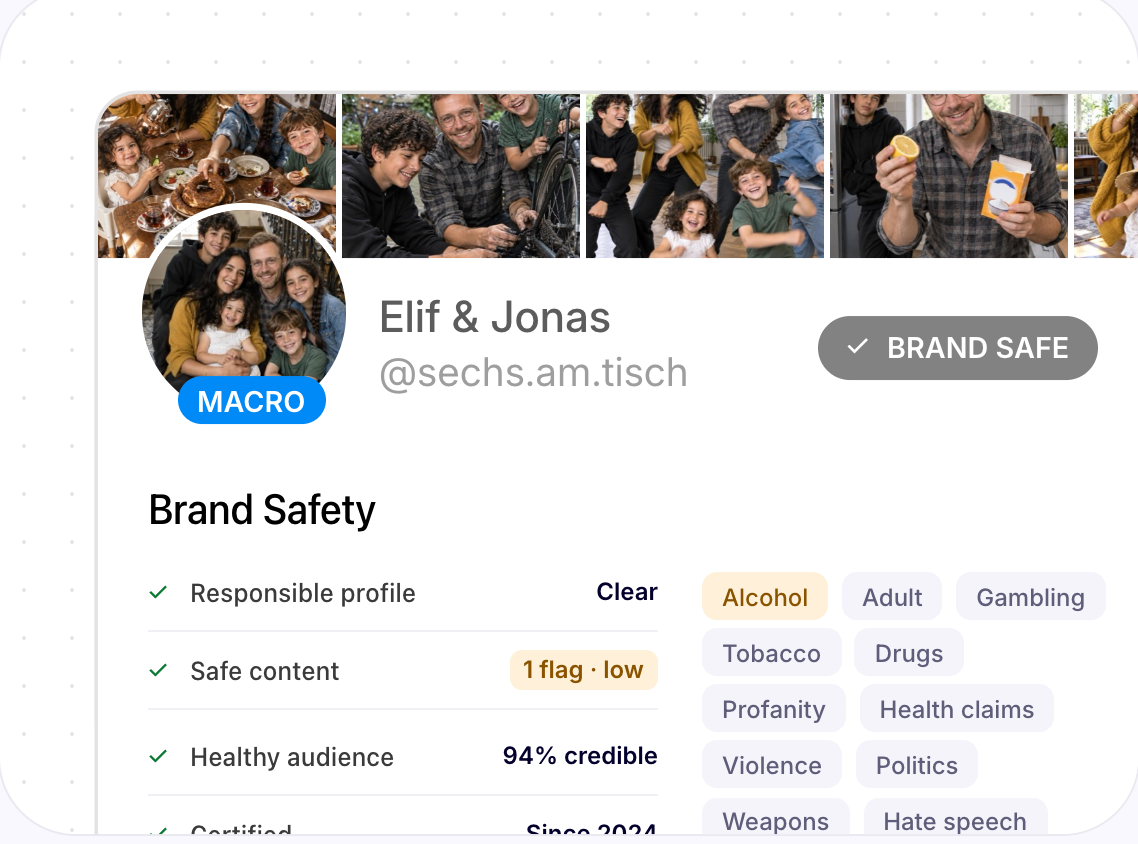
Every brand draws its lines differently. A spirits brand, a toy maker and a bank do not share the same red flags, which is why the categories in Stellar can be adapted to your own policy rather than a generic list.
Compliance Has to Live Inside the Campaign
Choosing the right creator is the first half. The second is making sure every post that goes live meets the standard, because under the Digital Fairness Act “we told them in the brief” will not be enough.
In practice, that means three habits:
- Put disclosure in writing. Spell out the label, its placement and the platform tools to use in every brief and contract.
- Approve before publishing. Review captions and visuals before they go live, so a missing label is caught as a draft, not as a post. Stellar lets you run content approval and manage briefs in one place, with the whole exchange documented.
- Monitor what actually goes out. Track every published post, including the ones that drift from the approved version, with live content monitoring and reporting.
Done well, this is not extra bureaucracy. It is the proof you will want to show if a regulator, or your legal team, ever asks how you made sure.
What Happens Next
The Digital Fairness Act is a proposal. The European Parliament and the Council will now negotiate the text, and the final rules and their start date may change along the way. Expect lobbying on the details, from the exact wording of labels to how far brand responsibility should reach.
Waiting for the final text is still the wrong strategy. The obligations it describes already exist in spirit under current EU consumer law and in national rules like France’s and the Netherlands’. The proposal simply makes them sharper, more uniform and much more expensive to ignore.
Conclusion
The Digital Fairness Act turns a long-standing grey zone into a clear expectation: if you pay for influence, you are responsible for how it is labelled.
Four things to take away:
- Disclosure becomes your job. Brands and agencies will have to ensure creators comply, not just hope they do.
- The stakes rise sharply. Fines of up to 6% of global turnover and direct enforcement by the Commission change the risk calculation for every campaign.
- Vetting gets a new criterion. A creator’s disclosure history, audience and brand safety record matter as much as reach.
- Proof beats promises. Written briefs, content approval and post monitoring are what show you did the work.
The good news is that none of this requires reinventing influencer marketing. It requires doing it with evidence. Stellar helps brands and agencies choose the right creators and run campaigns they can stand behind, on their own terms.
Ready for Influencer Marketing You Can Prove Is Compliant?
Check how creators disclose before you sign, approve content before it goes live, and keep a record of every post.
More articles
 BlogAI and Influencer Discovery in 2027: Beyond InstinctBy Sarah Levin Weinberg, Co-founder & CMO of Stellar. Most ambassador regrets are not bad luck. They are a question of method, and of access to the…
 BlogAI and Travel Influencer Marketing in 2027: Ready for Take-Off?By Sarah Levin Weinberg, Co-founder & CMO of Stellar. AI can now invent the most beautiful beach in the world. In travel, that is exactly why trust…
 BlogAI Shopping Assistants Read Your Creators. Do You?AI assistants now write the shortlist before your customer ever sees a product page, and they build it from what creators say. Here is what that…