Blog
AI Shopping Assistants Read Your Creators. Do You?
AI assistants now write the shortlist before your customer ever sees a product page, and they build it from what creators say. Here is what that means for your influencer programme.
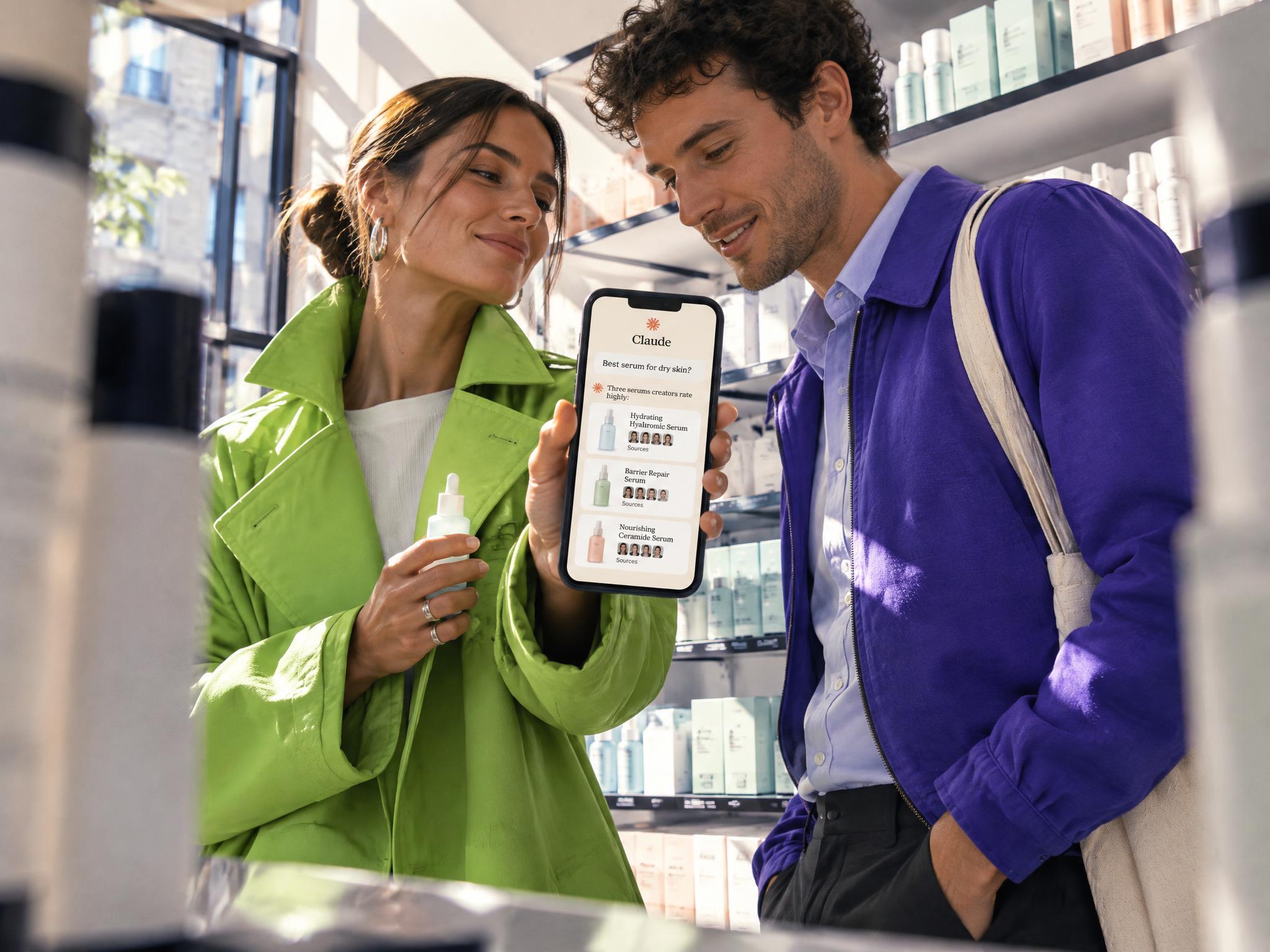
TL;DR: On 1 October, OpenAI added virtual try-on and saved favourites to ChatGPT shopping. The try-on gets the headlines, but the real shift happens a few questions earlier, when the assistant decides which products make the shortlist at all. Those answers lean heavily on what creators and real customers say online. In the UK, Germany and France, around two in three consumers already use AI tools, mostly to research and discover rather than to buy. Creator content has quietly become the raw material AI assistants recommend from, so your influencer programme now shapes what the machine says about you. The brands that get recommended will be the ones that choose credible creators, stay visible over time and keep a close eye on the conversation.
A Try-On Button, and the Shortlist Nobody Saw Being Written
On 1 October, OpenAI launched virtual try-on and a Favorites library inside ChatGPT shopping, rolling out globally on web and mobile. You upload a selfie, tap “Try On”, and see the jacket on yourself before you buy it.
It’s a clever feature. But it’s also the very last step of a journey that started several questions earlier.
Think about how people actually shop with an assistant. Before anyone tries anything on, they ask: “What’s the best waterproof jacket for cycling to work, under €200?” or “Which serum actually helps dry skin?” The assistant comes back with three or four products, a line on why each one made the cut, and a handful of sources. There’s no results page, no banner, no sponsored listing. Just a recommendation that sounds like advice from a friend who has done the reading.
So the question for brand marketers has changed. It used to be “Are we ranking?” Now it’s also “What is the AI reading about us, and who wrote it?“
More and more often, the answer is creators.
Europe Isn’t Waiting for Checkout. It’s Already Asking.
It’s tempting to file AI shopping under “American trend, coming soon”. The numbers say it’s already here.
In the first quarter of 2026, McKinsey’s ConsumerWise survey asked European shoppers for the first time how they use generative AI to research, compare and plan purchases. Here’s the share who had used AI tools in the previous three months.

What people use it for is just as telling. Among those who turned to AI for a purchase, roughly half did so to learn about a product or discover new brands. Fewer than one in four used it to actually check out.
That split matters. European shoppers aren’t handing their wallets to an agent. They’re handing it the research, which is exactly where opinions form and exactly where creator content does its work.
Younger shoppers are further along. According to Eurostat, 63.8% of 16 to 24-year-olds in the EU used generative AI tools in 2025, almost twice the 32.7% of the population overall.
And where the habit goes, the traffic follows. In the US, Adobe found that AI referrals to retail sites grew 393% year on year in the first quarter of 2026, and by March they converted 42% better than other traffic. People who arrive from an AI answer arrive ready to buy. Europe usually follows curves like this one with a delay, not with a different shape.
Creator Content Has Become the AI’s Source Material
This is the part most brands haven’t caught up with yet. AI assistants don’t invent their opinions. They assemble them from what’s publicly available, and a growing share of that is social content.
Adweek reported that YouTube appeared as a cited source in 16% of AI answers over six months, compared with 10% for Reddit. That makes sense once you think about it: reviews, walkthroughs and “I tested this for a month” videos are exactly what an assistant needs when someone asks which product to choose. Google keeps widening the funnel too, with AI Overviews now showing up on 43% of US searches, up from 15% a year earlier.
We’ve written about how Google turned creators’ posts into a search channel. AI answers go one step further. The post isn’t just found anymore. It gets summarised and repeated.
And consumers like it that way. In an IAB study of 2,200 people who had used AI for shopping research, UK respondents included, 56% said they prefer AI recommendations that include creator perspectives, and 65% feel more confident when those recommendations draw on credible creator reviews. Half of Gen Z and Millennials said they had discovered creators through AI.

Now for the uncomfortable bit. As eMarketer points out, brands have limited visibility into how these tools decide which creators to surface. A review you never paid for, posted by a creator you’ve never heard of, can become the sentence an assistant repeats to thousands of shoppers.
You can’t control that sentence. But you can know it exists. Stellar’s social listening finds the creators already talking about your brand, your competitors or your category, so you see what they’re saying, and where the conversation is heading, before it turns up in an AI answer. We’ve explained why social listening now decides your influencer results. In a market where AI does the recommending, it decides your inputs as well.
If AI recommends from creator content, the creator conversation about your brand is now part of your product page.
Reach Doesn’t Get You Quoted. Credibility Does.
When a new channel opens up, the instinct is to buy volume: more creators, more posts, more mentions. Here, that instinct will backfire.
Look at what IAB respondents said makes a creator worth trusting inside an AI answer.

Notice what’s missing: follower count isn’t on the list. And the most trusted type of creator wasn’t a celebrity at all: everyday consumers came out on top at 52%, ahead of professional reviewers. Among Western markets, UK respondents were the most cautious about creator-informed recommendations. For European brands, that’s a fair warning that a polished ad read won’t carry the same weight as an honest review.
So “the right creator” means something slightly different now. Follower count tells you how many people might see a post. It tells you very little about whether that post is the kind of detailed, consistent, honestly disclosed content an assistant will treat as evidence.
The good news is that you can find this out before you sign anything. You can analyse what a creator actually publishes, check whether their audience is real and look back at their past brand partnerships, so you know whether their feed reads like advice or like a string of ads. A creator who compared five competing serums last quarter, with clear disclosure, sends a far stronger signal than one who features a new brand every day.
In AI answers, the creators who get quoted are the ones who sound like they’d say the same thing unpaid.
One Campaign Is a Spike. The Machine Rewards Presence.
There’s one more twist, and it should give pause to anyone still planning influencer marketing as a series of launches.
Digiday reported on an analysis of thousands of sponsored YouTube videos showing that AI citations faded by around 43% within a month, with the citation rate falling from 18.4% to 10.5%. A burst of content can earn you a place in AI answers. It won’t keep you there.
The takeaway is simple. Brands that stay present, with a steady roster of credible creators publishing month after month, keep feeding the sources assistants draw from. Brands that go quiet between campaigns leave that space to someone else. It’s the case for always-on programmes, made this time by a machine rather than a strategist.
It raises the bar for measurement as well. If part of your influencer impact now shows up as AI-referred visits and recommendations instead of clicks on a link in bio, you need creator data sitting right next to your other channels. Stellar tracks reach, engagement, EMV and sentiment across your campaigns, and its API and MCP let you pull that data into your own BI tools, or ask for it directly from an AI assistant, as we showed in our piece on finding influencers from ChatGPT, Claude or Gemini.
Consistency isn’t just good brand practice anymore. It’s how you stay in the answer.
Conclusion
The ChatGPT try-on button is the visible part of a much quieter shift. The shortlist is now written by a machine, and the machine reads creators.
Four things to take away:
- The decision moves upstream. European shoppers already use AI to research and discover, not yet to buy. You win or lose before anyone reaches your product page.
- Creator content is source material. What creators say about your brand, paid or not, is increasingly what AI assistants say about it.
- Credibility beats reach. Shoppers trust AI answers built on honest, consistent and transparent creators. Choose partners for the substance of their content, not the size of their audience.
- Presence beats bursts. AI citations fade fast. A steady creator programme, measured alongside your other channels, keeps your brand in the conversation.
None of this calls for a brand-new playbook. It calls for looking at the influencer work you already do and seeing it for what it has become: the public record that machines check before your customer does. Stellar helps you see that record, shape it with the right creators and prove what it’s worth. The assistants are already reading. The only question is what they’ll find.
Do You Know What AI Hears About Your Brand?
See which creators already talk about your products, choose the ones whose word carries weight, and track the results across every channel.
More articles
 BlogFind Influencers From ChatGPT, Claude or Gemini: Stellar's MCP ExplainedStellar now speaks MCP, so ChatGPT, Claude or Gemini can find creators, check their audiences and build your campaign in seconds. Included in every…
 BlogWhy YouTube Views Are Higher: The Impact on Your EMV and ROISince 24 August 2026, YouTube counts a view from the very first frame of playback, across long-form, Shorts, live streams and podcasts. The old…
 Success StoriesHow Dijksman Communicatie chose 11 creators for BYD with StellarHow Dijksman Communicatie chose 11 creators for BYD with Stellar Book a demo When BYD brought the DOLPHIN SURF to the Netherlands, Amsterdam PR…