Blog
AI and Travel Influencer Marketing in 2027: Ready for Take-Off?
By Sarah Levin Weinberg, Co-founder & CMO of Stellar. AI can now invent the most beautiful beach in the world. In travel, that is exactly why trust, and the creators who earn it, matter more than ever.

By Sarah Levin Weinberg, Co-founder & CMO, Stellar Tech. Adapted from her keynote at the Travel Blog Awards 2026.
TL;DR: Travel does not sell a product. It sells a promise, and AI has made promises remarkably easy to fabricate. One in five hotel photos on booking platforms now shows signs of AI generation or editing, and a growing share of travellers ask an AI assistant where to go before they ever open a booking site. In my view, the brands that win will not be the ones that generate the most content. They will be the ones that use AI to understand travellers better, choose the right creators rather than the biggest ones, create honestly and prove real impact. AI proposes. Humans decide.
A Turquoise Lake That Was Never There
Picture a travel photo that stops your thumb mid-scroll. A turquoise lake, dramatic mountains, that perfect late-afternoon light. You save it. You might even start planning the trip.
Now imagine the person who posted it has never been there. Or that the lake has never looked like that at all.
For a long time, this was a creative question. Today it is a commercial one. In May 2026, the Berlin agency ABCD and the forensic verification firm ContentGuard.me analysed 25,550 hotel photos across seven destinations and found that roughly one in five carried at least one sign of AI generation or editing. The spread between destinations is striking, as the graphic below shows.

A word of caution, because nuance matters here. A flagged image is not automatically a deceptive one, and city hotels often illustrate their listings with landmark imagery that inflates the figures. But the direction is unmistakable: synthetic and enhanced imagery is already part of the booking environment.
And that matters more in travel than almost anywhere else. A fashion customer can try a jacket on in a store. A traveller buys a room, a view or a beach before anyone can test it. So the real question for hotels, destinations and the agencies that serve them is a simple one: will the experience match what we have shown?
That is where both the opportunity and the responsibility of AI begin.
Before Anyone Books, They Ask
Something else has quietly changed in how people plan their trips. They no longer just type “best hotels in Belgium” into a search bar. They ask an assistant something far more personal: three days in Belgium, hidden gems, no tourist traps, where should I go?
According to Simon-Kucher, 42% of travellers used AI-powered tools to plan their itinerary in 2025, and adoption varies enormously from one market to the next.

Europe is catching up fast. MMGY’s latest Portrait of European Travellers found that 52% of British travellers now use AI to plan their holidays, up from 40% a year earlier.
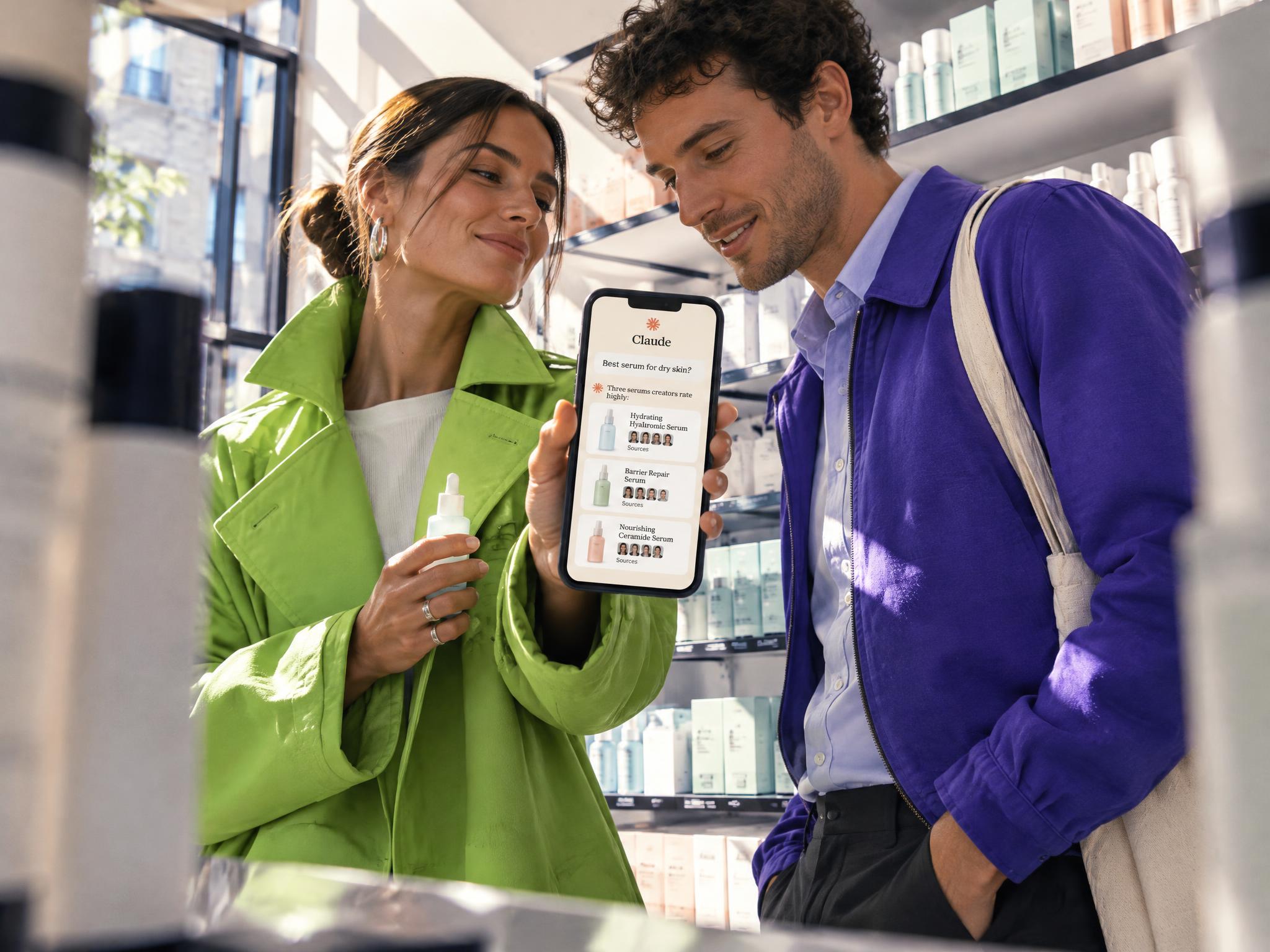
Here is the part I find most interesting for our industry. These assistants do not invent their recommendations. They assemble them from what is publicly available, and creator content sits at the heart of it: YouTube now appears as a cited source in 16% of AI answers, ahead of Reddit at 10%. Reviews, walkthroughs and honest “we tried it” videos are precisely the material an AI needs to answer a travel question. We explored this shift in more depth in how AI shopping assistants read your creators.
Generative engine optimisation is therefore no longer a search topic alone. It is an influencer marketing topic. And it touches every stage of a campaign:
- Understand what travellers actually ask AI.
- Select creators whose content can genuinely improve your visibility.
- Create useful, credible content that AI can pick up.
- Measure whether your destination is actually being recommended.
Understand: The Insight Is Rarely the Infinity Pool
Understanding means doing the research before choosing a campaign angle or briefing a single creator.
Take a family hotel in the Maldives. The team has two hundred guest reviews, the questions the reservations desk answers every week and search data from its key markets. Ask an AI tool to read them together. What makes families happiest? What worries them before they book?
Quite often, the answer is not the one on the brochure. The infinity pool may not be the main selling point at all. Parents may be far more concerned about how easy it is to arrive with young children, or whether connecting rooms are guaranteed.
That single insight reshapes everything that follows: your own brand content, and above all your creator brief. Show the journey. Answer the practical questions. Demonstrate the family experience rather than the postcard.
Select: Not “Is This a Good Creator?” but “Is It the Right One?”
This is where AI has changed the most, and where I see the biggest gap between teams that have adapted and those that have not.
For years, AI in our field mainly read: captions, keywords, hashtags, mentions. Today it also sees and listens. It can recognise a hotel’s name on a sign, a logo on a boarding pass, or a brand mentioned out loud in a video, with no tag and no hashtag at all. That is multimodal AI, and it opens entirely new ways of finding the right people:
- Visual search. Start from a mood board instead of a keyword, and surface creators whose content already shares that aesthetic.
- Social listening. Find the creators, guests and fans already talking about your hotel or destination, often already in love with it, which usually makes activation faster.
- Lookalikes. When one ambassador performed particularly well, use their content, topics and audience as a starting point rather than beginning from zero.
- Machine-learning recommendations. Combine your brand, the audience you need and the results of past campaigns to start from a relevant shortlist instead of thousands of profiles.
At Stellar, we built discovery that works by image, by content and by who already talks about you for exactly this reason. But one thing needs saying clearly: a match score is not a decision.
Finding people differently is only half of the shift. The other half is evaluating them far more deeply, and I like to think in three connected lenses:
- Profile: values, past partnerships and credibility.
- Content: performance, public response, claims and brand safety.
- Audience: authenticity, location, interests and real relevance to the campaign.
Imagine a tourism board promoting a Brussels city break to travellers in Germany. One creator has 1.2 million followers; another has 85,000, but a far more relevant audience and genuine travel intent. For this campaign, the second may well be the stronger partner. The comments tell the same story: are people asking for the hotel’s name, the train connection, a booking link? That is travel intent, and it rarely shows up in a follower count.
Brand safety also takes on a specific meaning in travel. Beyond the usual sensitive categories, it means looking out for overtourism, fragile natural sites, misleading green claims, undisclosed partnerships or promises about facilities that simply do not exist. Technology can analyse a creator’s content, audience and past partnerships across platforms and languages, and flag what deserves attention. As I like to put it: technology detects, the brand interprets.
Virtual Ambassadors: Interesting, Never a Shortcut
Some travel brands have gone one step further and created virtual ambassadors of their own.
In Brittany, Anne Kerdi, an AI-created personality who promotes the region, was named among the ten finalists of the first Miss AI contest. In Germany, the national tourist board launched Emma, an AI travel influencer who answers questions around the clock. In Belgium and the Netherlands, TUI introduced Lena, chosen by a panel of 2,000 people on one condition: that she always says she is AI.
Three different strategies, one common thread. They can add scale, availability and multilingual reach, but only with a clear purpose, full transparency and proper oversight. They should never be chosen simply because they are new.
Because there is something AI cannot fake. The wind. The detour. The people. The unexpected restaurant, the inconvenient transfer, even an honest disappointment. That specificity is exactly why audiences follow travel creators in the first place, and why a credible human endorsement remains so valuable. The question is not human versus AI. It is which role each one should play.
Create: Invent a Mood. Never Invent the Facilities.
With the research done and the right partners chosen, creation is where AI becomes most visible. Video, image and voice tools now let agencies explore concepts before production, turn one campaign into dozens of formats and adapt it for French, Dutch, German and English-speaking travellers in a fraction of the time.
That is a remarkable efficiency gain. But just because we can generate almost anything does not mean we should present it as reality.
Think of three sunsets:
- Fair use: a clearly illustrative image that evokes a mood rather than documenting a guest experience.
- Disclose: a visualised resort concept or an imagined scene, useful as long as viewers know what they are looking at.
- Misleading: an image suggesting that a real hotel offers a private infinity pool or a sea view that guests will never find.
The line is not “AI or no AI”. It is what the image implies about the experience people are about to buy. Regulation now agrees: since 2 August 2026, the EU AI Act’s Article 50 requires AI-generated images that could pass for real places or events to be disclosed.
And here lies a genuine paradox. The same technology that creates the risk also helps detect it. In a Which? test, 70% of people failed to correctly identify which videos were real and which were deepfakes. Meanwhile, Google has watermarked more than 180 billion images and videos with SynthID and opened its detector to the public. Detectors are not truth machines, and not every edited image is deceptive. The practical answer is to write clear content rules into the brief, require transparency where it matters and check that the real experience matches the claim.
Measure: One Million Views Is Not the Destination
A million views is impressive. It is not the destination. When I look at a travel campaign, I ask four questions:
- Reach: did we reach the right people, not just many people?
- Resonance: did they save, share, discuss and react positively?
- Action: did they search, click, enquire or book?
- Visibility: are we appearing more often in relevant conversations, search results and AI-generated answers?
Visit Brussels offers a telling example. The agency reported €1.46 million in earned media value from around €260,000 invested with 49 creators since 2023, while critics in parliament asked what the real return on investment was. Both sides have a point, and that is precisely the lesson: visibility metrics are necessary, but travel brands increasingly need to connect them to bookings.
That is harder in travel than elsewhere, because booking windows are long and the signals live in different places: campaign analytics in one tool, creator data in another, reservations in a CRM, briefs in a shared drive. This is where APIs and newer standards such as MCP change the game. An AI assistant connected to authorised tools can answer a question like which creators generated the strongest booking interest for our German city-break campaign, and how does that compare with sentiment and reach? At Stellar, we made our platform available through API and MCP so that creator data can sit next to everything else a team already measures, as we explained in finding influencers from ChatGPT, Claude or Gemini. Human checks remain essential, but AI becomes far more useful when the information is connected, not just when the chat gets smarter.
Conclusion
AI can now create the most beautiful beach in the world. That is precisely why the real one has never mattered more.
Four things to take away:
- Travel sells a promise. With synthetic imagery already on booking platforms, trust is the asset to protect first.
- Travellers ask AI before they book. Creator content feeds those answers, which makes influencer marketing part of how destinations get recommended.
- The right creator beats the biggest one. AI helps find and evaluate partners across profile, content and audience, but a match score is never a decision.
- Impact must reach the booking. Measure reach, resonance, action and visibility, and connect your tools so the evidence lives in one place.
As content becomes easier for everyone to generate, competitive advantage will not come from producing more of it. It will come from better insights, better decisions, truthful experiences and the ability to show real impact. Not replacing the journey with AI, but making the real journey more relevant, more discoverable and more measurable. Stellar exists to help brands and agencies do exactly that.
Ready to Choose Travel Creators on Evidence, Not Follower Counts?
Discover creators by image and conversation, evaluate them across profile, content and audience, and connect their impact to your bookings.
More articles

 BlogAI Shopping Assistants Read Your Creators. Do You?AI assistants now write the shortlist before your customer ever sees a product page, and they build it from what creators say. Here is what that…
 BlogFind Influencers From ChatGPT, Claude or Gemini: Stellar's MCP ExplainedStellar now speaks MCP, so ChatGPT, Claude or Gemini can find creators, check their audiences and build your campaign in seconds. Included in every…