Blog
AI and Influencer Discovery in 2027: Beyond Instinct
By Sarah Levin Weinberg, Co-founder & CMO of Stellar. Most ambassador regrets are not bad luck. They are a question of method, and of access to the right data. Here is how AI changes the way brands choose who speaks for them.
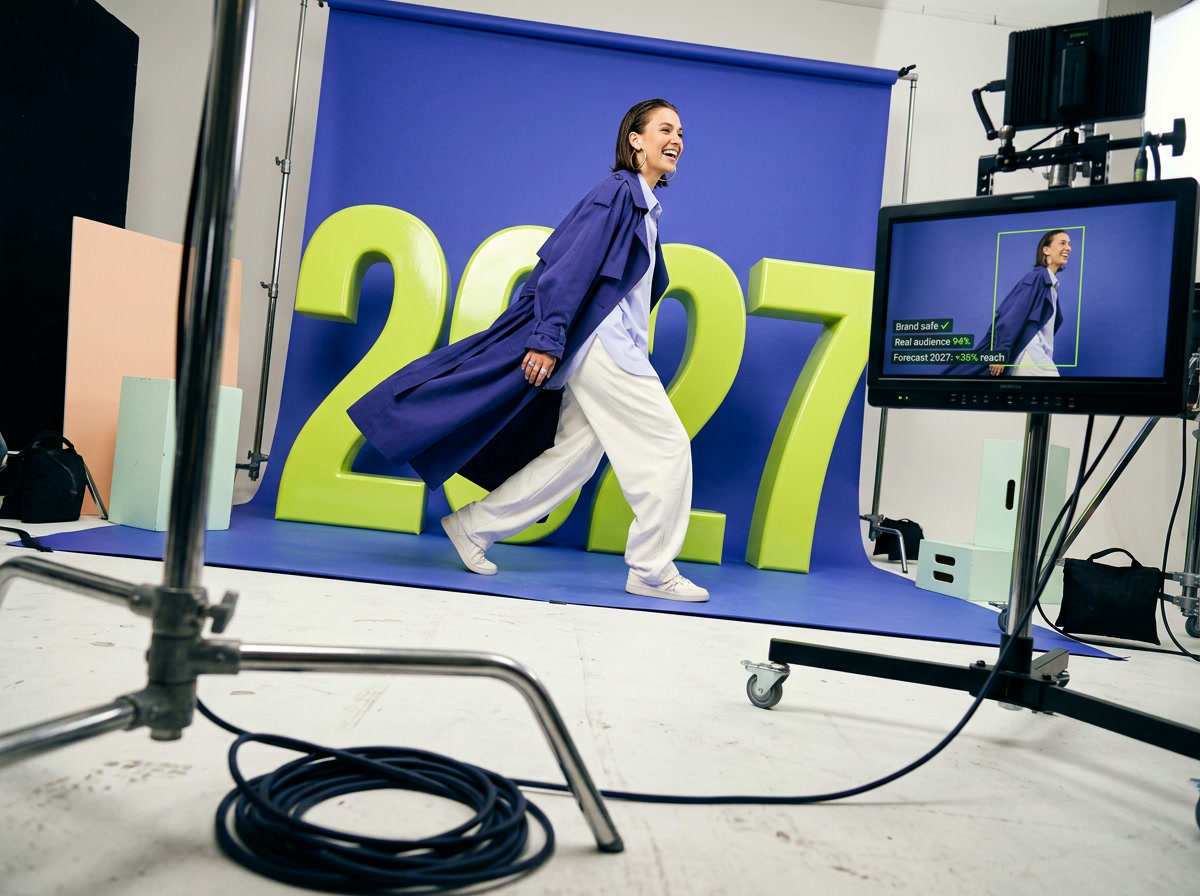
By Sarah Levin Weinberg, Co-founder & CMO, Stellar Tech. Adapted from her webinar for the Union des Marques.
TL;DR: Choosing a brand ambassador used to be a matter of taste, a few screenshots and a good feeling. That is no longer enough. With hundreds of millions of creators, budgets that must be defended line by line and a public that judges brands on their reputation first, instinct alone has become an expensive way to decide. AI now lets brands find creators by image, by conversation and by proven fit, then evaluate them in depth across profile, content and audience before a single contract is signed. It does not replace judgement. It gives judgement far better material to work with.
Most Ambassador Regrets Are Not Bad Luck
Let me start with a simple question. Have you ever signed an ambassador and regretted it afterwards?
The reasons vary, but they tend to look familiar:
- An old post resurfaces in the middle of your campaign, the kind of skeleton every brand hopes to avoid.
- The audience turns out to be less real than the dashboard suggested.
- The performance disappoints, even though the statistics looked perfect on paper.
If you recognise yourself in any of these, you are far from alone. And here is the good news: it was probably not a question of luck. It was a question of method, and above all of access to the right data. That data now exists, which means the problem can be solved.
Why Instinct No Longer Scales
AI is already everywhere in our industry. When we surveyed 936 marketers and creators across five markets for our study on the use of AI in influencer marketing, 90.7% of professionals and 82.3% of creators said they already use it, to brainstorm, generate images and videos, analyse data or optimise posts. In short, for creativity on one side and data on the other.
That should not surprise anyone, because the pressure comes from both directions.
On the creative side, the feeds are overflowing. Linktree estimates that roughly 200 million creators are now competing for the attention of audiences who already scroll past hundreds of pieces of content a day. Standing out requires more creativity, ideally without a matching rise in cost.
On the data side, nobody can review that volume by hand. And the stakes keep rising: in Influencer Marketing Hub’s 2026 benchmark, 87% of respondents expect their influencer marketing budget to increase. More budget means more scrutiny. Every decision has to be justified and every euro defended. We can no longer afford to choose on instinct, or to skip the measurement.
Reputation Now Comes Before Image
There is a third reason, and to my mind the most important one: reputation.
A study by Ifop for Media Figaro, conducted among 1,500 people in France and presented in June 2026, shows that reputation has overtaken both image and awareness as the factor that most influences how consumers choose a brand.

The same study found that 52% of respondents have already boycotted a brand after reading negative information about it. In that context, the creator who speaks on your behalf is not a media buy. They are part of your reputation.
You might object that if reputations have become so fragile, AI is largely to blame. And you would be right. Deepfaked ambassadors, fake creators posing as real ones, fabricated reviews and manufactured outrage: much of this is powered by AI.
This is what I call the AI paradox. AI creates and amplifies many of these risks, and at the same time, it is AI that will protect us from them. No human team can manually review a creator’s full history across five platforms, or spot a deepfake in real time. An AI can, and it can surface to a human only what genuinely deserves their attention.
What Changed: AI No Longer Only Reads. It Sees and Listens.
When we talk about AI in influencer marketing, there are two broad families. One is creative: generative tools, avatars, voice cloning, used to produce and amplify content at scale. The other is analytical: machine learning, natural language processing, predictive models and sentiment analysis, used to find the right profiles, read audiences, detect risks and anticipate performance. Choosing the right ambassador happens mostly in the second family, so that is where I want to focus.
For years, analysis in our field meant reading text: captions, hashtags, mentions, written comments. Useful, but partial, because influence today is video, images, audio and stories without a single caption.
It is not that AI could not handle these formats before. It is that it now does so with a precision and accessibility that change everything. This is multimodal AI. It no longer simply reads. It sees, it listens and it understands visual and audio context. In practice, a brand can now be detected:
- When it is written on screen, through text recognition in images and video (OCR).
- When it is only spoken aloud, through automatic transcription.
- When it is neither written nor spoken, because the product or logo is visible in the frame.
Anyone who sells through retailers will recognise the next situation. A creator tags the store, forgets to tag the brand, and the post disappears from your reporting. With these techniques, the brand, the retailer and even a co-branding partner can all be identified in the same video, whether or not anyone remembered to tag them. Everything that follows rests on this foundation: an AI that can finally analyse what a creator actually does and says, not just what they choose to declare in a bio or a caption.
Four Ways to Find the Right Creator
For a long time, there were one or two ways to identify a potential ambassador. AI now offers four:
- Search by image. Start from a mood board or a visual that captures the world you want, and let computer vision find creators whose aesthetic and style already match it. You begin with an intention, not a keyword.
- Social listening. Probably the most powerful of the four. Instead of searching for people who fit your criteria, you start from the existing conversation: which creators, customers and fans already talk about your brand, spontaneously? You no longer start from zero. You start with people who already like you.
- Lookalikes. You have an ambassador who performs brilliantly for you. AI analyses their visual style, tone, vocabulary and audience, and finds other profiles that resemble them. One success becomes the starting point for the next.
- Machine-learning recommendations. One step further. The model looks at your brand DNA and your past results (which campaigns worked, on which formats, with which profiles) and combines them with an analysis of each creator’s values to assess brand fit. Instead of 50,000 profiles, you start from a shortlist shaped by what has already worked for you.
At Stellar, we built creator discovery by image, by conversation, by lookalike and by recommendation for exactly this reason. With these four approaches, the suggested profiles are often so relevant that a large part of the selection work is done before the analysis even begins. And for the analysis itself, AI now helps far more than it used to.
Not “Is This Creator Good?” but “Are They Good for Us?”
For years, we judged an influencer on two criteria: is the content good, and are the average numbers good? Both still matter. Neither is sufficient any more. The real question is whether this creator is right for us, and AI makes it possible to answer it across three dimensions: who the person is, what they produce, and who follows them.
Profile: Who Is This Person, Really?
The first pillar covers who the creator is, where they are based, how they behave and, increasingly, whether they are human at all. We used to ask that question about followers. Today we have to ask it about creators themselves, because undisclosed virtual profiles are starting to appear on marketplaces and in creator databases. An undisclosed virtual influencer promoting your product does not only carry their own risk. It engages your brand’s responsibility.
AI can classify an account from a range of signals, reconstruct its history of brand collaborations (is it consistent with your world, is there a conflict with a direct competitor?) and look at behaviour over time, across social networks and the wider web. Not every stance a creator has taken ends up in their bio.
Content: Performance, Resonance and Safety
The second pillar is content, and here most brands look at only one dimension of performance: reach, engagement, views and conversions. That is the familiar part. AI lets us look further:
- Resonance. How is the content received? Is the audience enthusiastic, sceptical or critical, especially during sponsored posts? Comment and sentiment analysis separates a creator who performs on the surface from one who generates genuine support.
- Community pick-up. Did past campaign content inspire other content: duets, replies, spontaneous posts from the community? An ambassador who publishes one post that inspires fifty organic ones has just delivered fifty pieces of free content. Multiply that by the reach of each new voice, and the real return of a campaign looks completely different.
Then comes safety. Anyone who has discovered a problematic old post after a campaign launch knows exactly why this step is critical. AI can review a creator’s entire history quickly and at scale to flag sensitive topics. At Stellar, we cover around ten common risk categories, from hate speech to drugs, weapons or adult content, but every brand should then define its own filters according to its values and sector, whether political, ESG or industry-specific. AI also makes it far faster to check, once posts are live, that partnerships are properly disclosed. A creator who ignores advertising transparency rules is not only taking a risk themselves. They create legal and reputational exposure for the brand. You can analyse a creator’s content, audience and brand safety in one place before you commit.
Audience: The Right One, and a Real One
The third pillar is the audience. Demographics, interests and location are familiar territory. What I want to stress is that AI is what solved the burning issue of influencer marketing a decade ago: audience authenticity. Fake accounts, bots and suspicious engagement spikes are now detected automatically by machine learning trained on millions of profiles.
Two million followers are not necessarily two million people. If half of them are inactive or fake, you are paying full price for an audience that does not exist. What has changed is that this check is now automated, and non-negotiable.
When Is a Creator Truly “Brand Safe”?
Put the pillars together and you arrive at a precise definition. A creator is brand safe when four lights are green at the same time:
- A responsible profile, aligned with the brand’s values.
- Safe content, with a clean history and properly disclosed partnerships.
- An authentic, relevant audience.
- A recognised certification, such as the ARPP’s responsible influence certificate in France, which covers part of the above and signals professional behaviour during campaigns.
Only when all four are green should you commit. Without that, even the most talented creator can become a risk.
Before You Sign: Forecast, Then Check the Overlap
Two further capabilities are changing how ambassadors are chosen.
The first is forecasting. By combining predictive analysis with machine learning on campaign history, it becomes possible to estimate in advance ranges for reach, engagement, earned media value and even expected CPM or CPE for a group of creators. It is not an exact science, and you should be wary of anyone who promises you the precise figure. But it transforms the conversation with your finance team. You no longer say “we hope it will work”. You say “based on this creator’s history and comparable campaigns, here is the expected order of magnitude, with its margin of uncertainty”.
The second is audience overlap, the last check before signing and the one most often forgotten. If you already work with three ambassadors and a fourth shares 95% of their audience, you are not reaching anyone new. You are speaking four times to the same people, and paying four times. AI builds a signature of each audience (interests, demographics, behaviour) and calculates how much they overlap, so that your roster genuinely covers different publics and a “niche” creator turns out to have a genuinely niche audience.
The Selection Continues After Launch
Once a campaign is live, measurement should happen in real time, because as long as it is running, everything can still be adjusted, including the selection itself.
That means looking at the quantitative (reach, views, conversions) and the qualitative (resonance, community pick-up and audience sentiment) side by side, to understand who is truly delivering. The creator with the most views is not always the one driving the most conversions or the warmest response. It changes how decisions are made mid-campaign:
- An ambassador faces a backlash? Reduce or pause their posts.
- Another performs beyond expectations? Ask for more, or activate similar creators who were not part of the original plan.
A campaign is a living thing. Until the last day, the selection can still be corrected. This is where measuring creator performance and sentiment in real time pays for itself.
Conclusion
An influencer campaign can be won before the first post goes live, in the choices made upstream. That is precisely where AI makes the difference: fewer risks, more certainty. The question is no longer how to rescue a campaign that has gone off track. It is how to win it before it begins.
Four things to take away:
- Ambassador regrets are a data problem, not bad luck. The information you need to avoid them now exists.
- Search differently. Image search, social listening, lookalikes and recommendations start you from intent, conversation and proven fit rather than follower counts.
- Evaluate deeply. Profile, content and audience, plus certification, must all be green before you commit, and forecasting and overlap checks belong in every pre-signing review.
- Keep selecting after launch. Real-time measurement turns a campaign into something you can steer.
That said, never rely on data alone. Meet your ambassadors. Co-create. Let them create. Think creator-led. Success comes from genuine human alignment with the creator and content that truly connects. And when the relationship is strong, a misjudged tone or a wrong call is corrected faster, and more naturally.
AI gives you the best possible start. The rest is up to you.
Ready to Choose Your Next Ambassadors on Evidence, Not Instinct?
Find creators by image and conversation, vet their profile, content and audience in depth, and forecast results before you sign.
More articles
 BlogAI and Travel Influencer Marketing in 2027: Ready for Take-Off?By Sarah Levin Weinberg, Co-founder & CMO of Stellar. AI can now invent the most beautiful beach in the world. In travel, that is exactly why trust…
 BlogAI Shopping Assistants Read Your Creators. Do You?AI assistants now write the shortlist before your customer ever sees a product page, and they build it from what creators say. Here is what that…
 BlogFind Influencers From ChatGPT, Claude or Gemini: Stellar's MCP ExplainedStellar now speaks MCP, so ChatGPT, Claude or Gemini can find creators, check their audiences and build your campaign in seconds. Included in every…