
TL;DR: Khaby Lame’s transformation from viral TikTok creator into a near-billion-dollar business, including the use of AI to replicate his persona, marks a turning point for influencer marketing. For brands, the case highlights why creator partnerships now require long-term monitoring, contextual understanding and clear governance, far beyond individual campaigns.
From Viral Fame to a Scalable Business Model

Khaby Lame’s rise is one of the most recognisable success stories of the creator economy. From unemployment during the pandemic to becoming the most followed creator on TikTok, his silent reaction videos turned him into a global cultural figure.
What is unfolding now, however, goes far beyond a typical influencer success narrative.
In recent months, multiple international outlets have reported that Khaby Lame has sold stakes in his business at a valuation close to $900 million, while simultaneously expanding a strategy that includes AI-generated versions of his own persona. Publications such as eMarketer describe how creators like Lame are converting viral fame into structured, scalable businesses that operate independently of constant physical presence.
This is not a publicity stunt. It is a signal.
Why This Deal Matters to Global Brands
The precise valuation matters less than what it represents. Khaby Lame is no longer operating primarily as a creator participating in brand campaigns. He functions as a media brand, a licensable identity and a technology-enabled business model whose value extends beyond platform reach alone.
According to Manager Magazin, the reported deal reflects the monetisation of Khaby Lame’s global brand value and diversified commercial interests, rather than follower numbers or short-term campaign performance alone.
What makes this development especially relevant for marketers is efficiency at scale. AI-enabled creator models allow brands to produce, adapt and localise content across markets without requiring constant physical involvement from the creator. This logic is already well established on the brand side.
Unilever, for example, has publicly confirmed that it is integrating generative AI into its marketing operations, using NVIDIA’s Omniverse technology to create digital twins of products for brands such as Dove, Vaseline and TRESemmé. According to Unilever and its technology partners, this approach significantly reduces production costs, shortens content creation cycles and enables faster localisation across markets.
What Unilever demonstrates at brand level is now emerging at creator level. In Khaby Lame’s case, AI is not used merely to optimise workflows, but to extend identity itself. His visual language, gestures and persona become reproducible assets that can be deployed across formats, markets and partnerships with far greater speed and consistency.
For brands, this fundamentally reframes creator partnerships. Collaborations no longer involve individuals alone, but ecosystems that may include AI-generated personas, licensing structures and long-term commercial strategies. While this increases efficiency and scalability, it also introduces new requirements around governance, transparency and brand safety. The key challenge for marketers is no longer access to reach, but maintaining visibility and control as creator identities become modular, scalable and increasingly technology-driven.

When Creators Become Replicable Assets
What makes this case particularly relevant is the role of artificial intelligence. As reported by Business Punk, Khaby Lame is building a system in which his visual language, gestures and persona can be reproduced using AI, allowing content and brand integrations to scale without his direct involvement.
This represents a structural shift in influencer marketing. AI is no longer merely a tool that supports content production. It becomes part of the creator’s commercial infrastructure, a way to extend presence, output and consistency across markets.
For brands, this fundamentally changes how creator partnerships must be understood. When AI-generated versions of a creator are used, authorship and control become less clear-cut. Questions of tone, messaging and boundaries can no longer be resolved solely at the start of a campaign, because output can scale faster than personal oversight. At the same time, transparency becomes a critical trust factor. Audiences increasingly expect clarity around whether content is human-created, AI-assisted or fully generated and ambiguity can undermine credibility even when the creator’s image remains consistent.
Most importantly, brand alignment is no longer static. AI-driven creator output evolves continuously, which means that narratives, themes and public perception require ongoing observation rather than one-time approval. The Khaby Lame case illustrates how creator partnerships are turning into long-term, technology-enabled relationships that demand governance models capable of keeping pace with scale.
For brands, this means operating within an environment where content removal may occur more swiftly, where reach can decline without warning, and where posts once considered harmless may be downgraded by automated systems. Creator accounts have already reported that minor issues such as incomplete ad disclosure can limit visibility. The platform appears to be tightening compliance proactively in anticipation of further regulation.
In this environment, brands must resist the temptation to rely solely on TikTok. Campaign setups need the flexibility to shift creators and content quickly toward Instagram Reels or YouTube Shorts if needed. Platforms such as Stellar Tech empower that adaptability by enabling teams to identify creators with stable performance histories, monitor potential policy risks and maintain alternative options for campaign continuity.
Why This Is Not an Isolated Case
Khaby Lame is not an exception. He is an early and highly visible example of a broader transformation in the creator economy. What we are witnessing is not simply higher creator earnings, but a shift in how influence itself is organised and monetised.
As reported by Watson and 20 Minuten, deals of this magnitude signal a new way of valuing creators, especially once AI becomes part of the equation. Influence is no longer assessed primarily through reach or engagement, but through scalability, licensing potential and long-term commercial architecture.
For brands, this means that collaborations increasingly connect them to entire ecosystems rather than individual personalities. A creator’s audience becomes infrastructure, identity becomes modular and partnerships extend beyond campaign timelines into evolving networks of technology, IP and narrative control. The key question is no longer how many views a creator generates today, but what kind of system a brand is entering and how that system may evolve tomorrow.
Brand Safety in Stellar: Making AI-Driven Creator Risk Visible
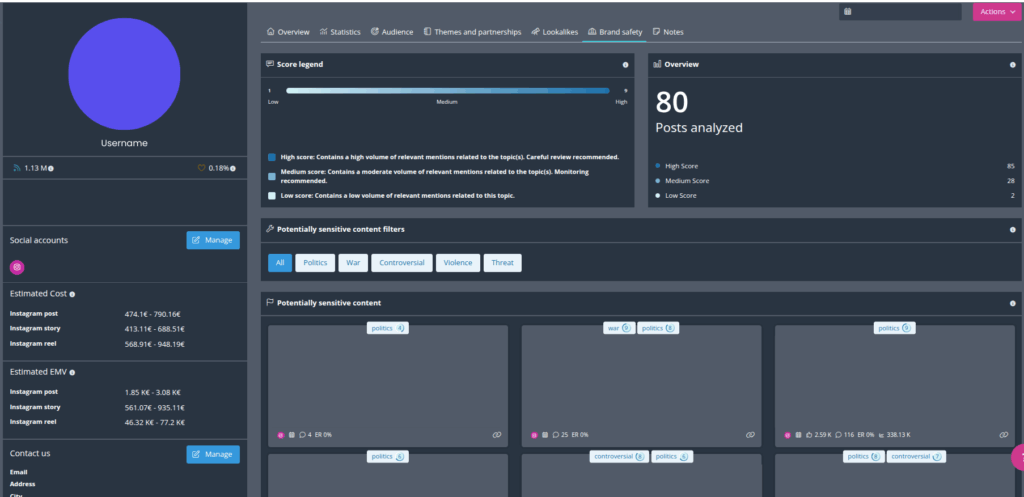
In practical terms, Stellar’s Brand Safety feature supports brands in navigating exactly these emerging risks by adding a structured layer of early signal detection. Stellar systematically analyses an influencer’s publicly available textual content across platforms, including captions, post text and story text, in multiple languages. This content is classified into defined sensitivity categories such as politics, violence, controversial topics or alcohol, providing a consistent framework for risk assessment.
Crucially, detected signals are not automatically blocked or excluded. Instead, they are contextualised over time: brands can see what was said, how frequently similar topics appear and whether certain narratives are becoming more prominent. Covering the last few months and updated daily, the analysis enables Stellar teams to identify narrative shifts and potential reputational pressure early on, long before AI-driven strategies by creators, licensing decisions or public positioning escalate into mainstream controversy.
In an environment where creators increasingly operate as hybrid human AI brands, Brand Safety in Stellar functions as a decision-support layer. It enables informed, defensible choices based on historical context and evolving patterns, rather than reactive judgments triggered by isolated incidents.
Continuous analysis of reach, engagement dynamics, sentiment shifts and conversion behavior becomes the foundation upon which content decisions can be made. Historical performance data serves as a crucial differentiator. It enables brands to determine whether sudden drops in visibility are part of a wider ecosystem change or isolated anomalies.
Stellar Reports and Sentiment Analysis offer precisely this clarity. Teams can evaluate content performance through reliable metrics, understand audience reactions as they evolve and adjust campaign direction without delay. With real-time intelligence, budgets can be shifted, timelines adjusted and narratives recalibrated before campaigns lose momentum.
Why 2026 Will Be a Defining Year for Influencer Marketing
The dynamics revealed by Khaby Lame’s deal are not isolated developments, they reflect a broader structural shift in the creator economy. As outlined in the Stellar Tech Trend Guide 2026, marketers are being forced to rethink how creativity, artificial intelligence and brand safety interact in practice. Influencer marketing is moving away from isolated activations toward integrated, data-driven ecosystems where creators operate as long-term, technology-enabled brands rather than short-term media placements.
In this context, success is no longer defined by who scales fastest, but by who understands how influence evolves, how technology reshapes identity and how relationships can be governed over time. Khaby Lame’s transformation into a scalable, AI-enabled brand is therefore not a curiosity, but a preview of what lies ahead. For global brands, influencer marketing maturity is no longer measured by reach alone. It is defined by the ability to understand context, anticipate change and build structures that make trust scalable in an AI-driven creator economy.
Ready to work with certified creators?
Book your demo and discover how Stellar helps you combine compliance and performance.
This article is brought to you by Stellar
Stellar is a SaaS platform for influencer marketing, developed by the French-Belgian company Stellar Tech and used in more than 35 countries. By using artificial intelligence, including social listening and sentiment analysis, Stellar enables companies to carry out influencer marketing campaigns in a simple and informed manner. The platform helps identify relevant ambassadors, analyse their profiles and target audiences, manage campaigns, and predict and measure the performance and ROI of these campaigns on social networks.
They trust us: La Redoute, Disney, Heineken, Air France, revolvR agency, Garmin France, Wurth France, Sonos Europe…